
TikTok for treatment centers works best as a trust builder, not an admissions channel. Post short, plain videos of your staff explaining what treatment is like, never film patients, and keep every claim modest. Done that way, it reaches families and adults under 50 who may never see your website first.
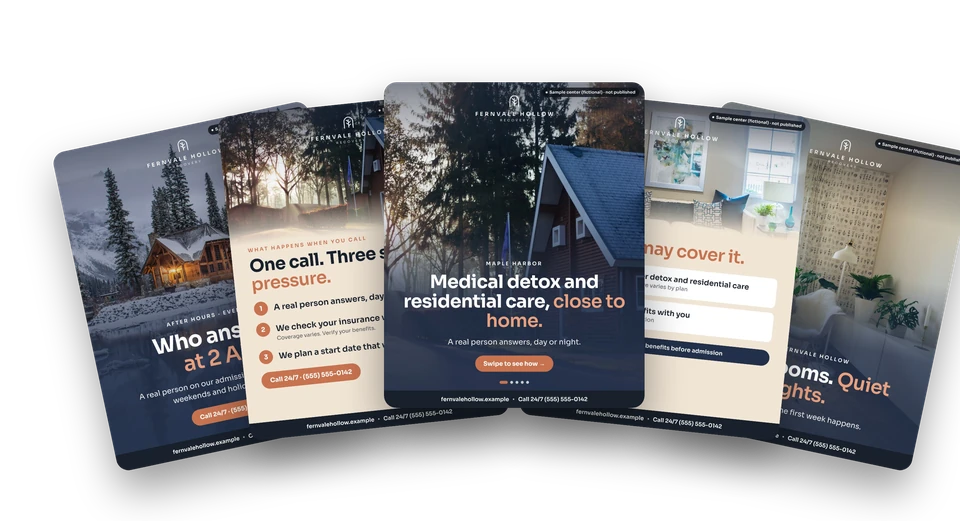
Owners usually have the same two worries: "Isn't TikTok for kids?" and "Won't we get in trouble?" Both are fair. Here is what the numbers say, what to post, and what to keep off the account.
Should your treatment center be on TikTok?
TikTok is no longer just a teen app. In a Pew Research Center survey, 37% of U.S. adults said they use it (Pew Research Center).
| Age group | Share of U.S. adults on TikTok |
|---|---|
| Under 30 | 63% |
| 30 to 49 | 44% |
| 50 to 64 | 30% |
| 65 and older | 12% |
Source: Pew Research Center.
Those middle rows matter. A parent in their 40s or 50s looking for help for an adult child is often the person who makes the first call. Pew also found that 20% of all U.S. adults regularly get news on TikTok. People use it to learn, not only to scroll.
TikTok is a good fit if you serve young adults, run IOP or PHP programs, or want families to see your team before they call. It matters less if most of your admissions are older adults referred by physicians. Even then, a small rehab TikTok account can reuse the same videos you post elsewhere.
What to post: TikTok for treatment centers, week by week
The videos that work are short, honest and specific. Staff talk to the camera. Rooms are shown empty. Questions families actually ask get direct answers.
| Day | Video | Who's on camera | Length |
|---|---|---|---|
| Monday | "What happens on your first day here" walkthrough | Admissions or nursing staff | 30 to 60 seconds |
| Tuesday | One common question answered ("Can I keep my phone?") | Any staff member | 15 to 30 seconds |
| Wednesday | Meet the team: why one person does this work | One clinician or tech | 30 to 45 seconds |
| Thursday | A space on campus, shown empty | Voiceover only | 15 to 30 seconds |
| Friday | A family question ("What should we pack?") | Family program or admissions staff | 30 to 60 seconds |
Five videos a week is a realistic starting point for TikTok marketing for addiction treatment. If that's too much for your team, three done well beats five done badly. For a full weekly schedule across platforms, see how often a rehab should post on social media.
A few things that help every video:
- Say the point in the first two seconds. "Here's what detox actually looks like" beats a slow intro.
- Add captions. Many people watch with the sound off.
- Shoot on a phone. Polished ads look like ads. A nurse talking plainly looks like a real place.
- Use your real name and location in the profile so local searchers can find you.
What to keep off your TikTok
This is where treatment centers get hurt. Most of it comes down to patient privacy, claims and money.
- Patients, ever. No faces, voices, names, backs of heads or people in the background. Federal privacy rules for substance use treatment are stricter than general healthcare. Our guide to HIPAA and 42 CFR Part 2 on social media covers the basics.
- Outcome claims. No success rates, "cures" or before-and-after promises.
- Drugs and paraphernalia. Keep them out of frame, even to make a point. It's the wrong image for a family deciding whether to trust you.
- Trends that joke about addiction. A popular sound can turn a serious message into a punchline.
- Music you don't have rights to. Business accounts are limited to TikTok's commercial music library in the app. Don't work around it with trending songs.
- Paying creators per referral. Paying anyone based on the number of patients they send you can run into federal anti-kickback law (18 U.S.C. 220). More in EKRA and treatment center marketing.
Handling comments and DMs
TikTok comments move fast, and some will come from people in crisis. Decide before you launch who reads comments, how often, and what they say.
A simple rule: never ask for personal or clinical details in public. Thank the person, give your admissions phone number, and point anyone in crisis to the 988 Suicide & Crisis Lifeline, which they can call or text at 988 (988 Lifeline). For treatment information, SAMHSA's free, confidential National Helpline is 1-800-662-4357, open 24 hours a day (SAMHSA). If someone says they are a former patient, don't confirm it.
TikTok ads vs organic posting
Paid advertising for addiction treatment is restricted across the major platforms. LegitScript says its certification is needed to advertise addiction treatment on Google, Meta, Microsoft and Nextdoor (LegitScript). TikTok has its own ad policies, so check them before running anything paid.
Organic posting is different. You're publishing to your own account, not buying placement. That's where most centers should start, and it's the only thing FirstCall does.
What a TikTok account costs your team
The app is free. The time isn't.
| Who runs it | What it takes | Main risk |
|---|---|---|
| A staff member | Planning, shooting, editing, posting and daily comment checks, on top of their real job | It stops when they get busy or leave |
| A freelancer | Your time to brief, review and sign off | May not know patient privacy or referral rules |
| A done-for-you agency | A monthly fee and a little of your time | Pick one that knows treatment, and ask the right questions |
How FirstCall Social does it
FirstCall Social runs organic social media for addiction treatment, detox and behavioral health centers, TikTok included. We plan the content, write it, check it against the rules, and post it. You get a preview of the coming week every Friday, for your information.
- Flat monthly fee: Essentials $997, Core $1,997, Premium $2,997, Elite $4,997 (pricing).
- 5 to 20+ posts a week, depending on plan, with TikTok included on Premium and Elite.
- Live within 10 business days of kickoff.
- About 2 hours of your time in week one, then about 15 minutes a month.
No paid ads, no per-lead fees, no patient stories. See how it works and the rules we follow on our compliance page.
Frequently asked questions
Can a rehab have a TikTok account? Yes. Set it up as a business account under your center's real name and follow TikTok's community guidelines. Keep content educational and staff-led, and never show patients.
Can treatment centers advertise on TikTok? Paid ads for addiction treatment are restricted across platforms, and certification is required on several of them (LegitScript). Check TikTok's current ad policies first. Organic posting doesn't involve buying ads.
Can we post alumni or patient stories on TikTok? We don't recommend it. Even with consent, a story can identify someone and stay online for years. Staff explaining the process builds the same trust with less risk.
How often should a treatment center post on TikTok? Consistency matters more than volume. Start with what your team can keep up every week, even three videos, and build from there.
Is TikTok worth it if most of our patients are older? Possibly. Pew found 30% of adults 50 to 64 use TikTok (Pew Research Center), and adult children often help a parent find care. If time is tight, put TikTok after the platforms your families already use.
See a sample week
Want your social media handled without adding to your team's week? See what your feed could look like first. Get a free sample week, built from your website.
This article is general information, not legal advice. Talk to a healthcare attorney about your center.
Keep reading
- Facebook for treatment centers: what to post, and what to avoid
- LinkedIn for treatment centers: how to reach referral partners
- Google Business Profile for rehab centers: weekly posts that help locals find you
- Detox center marketing: a social media playbook for withdrawal management programs
This article is part of social media for treatment centers: the basics. Browse every guide by topic.
Planning for your market? See social media for treatment centers in your state, compare our flat monthly pricing, or grab the free 30-day calendar.