
Facebook for treatment centers is less about going viral and more about one quiet moment: a parent, a spouse or a case manager opens your page to decide whether to call. Your page needs to answer three questions in a few seconds. Is this place real? Is someone there right now? Do they treat what my person needs? A current, honest page answers all three. A page that last posted in spring answers them the wrong way.
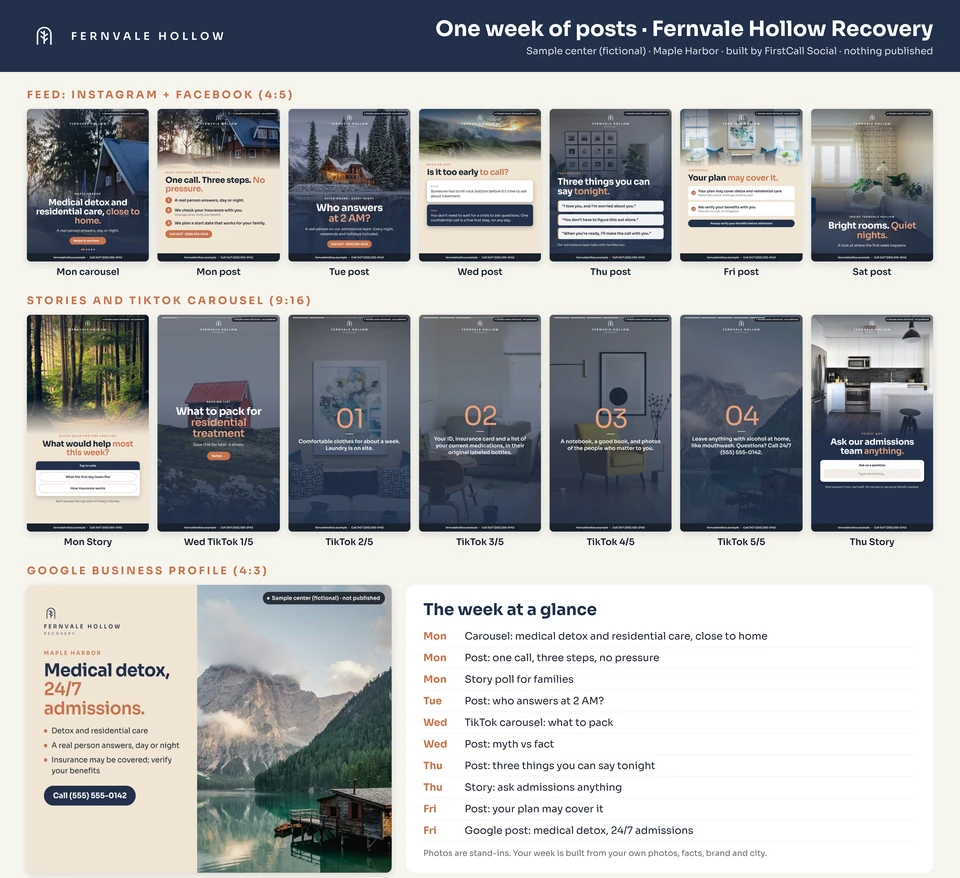
This guide covers who checks your Facebook page, a 10-minute page audit, six post types that work, what to keep off the page, and a sample week you can copy. It's general information, not legal advice.
Who checks your Facebook page
Instagram and TikTok reach the person who may need care. Facebook often reaches the people around them:
- Parents and spouses. Often the ones researching late at night and making the first call. They look for a real address, real staff, clear levels of care and a phone number that gets answered.
- Referral partners. Therapists, case managers, hospital social workers, probation officers and other programs want to know who you take, what you require and how a referral works.
- Your own community. Alumni families, local employers and neighbors who share posts about events, open houses and resources.
Write for the family member first. If a referral partner can find who you serve and how to reach admissions in the same post, even better.
The 10-minute page audit
Before you post anything new, look at your page the way a worried parent would, on a phone:
- Last post date. If it's more than a week ago, that's the first fix.
- Phone number. It should match your website and any ads exactly, and it should ring at admissions.
- About section. Your levels of care, your city, your hours and your license wording, in the same words your state uses. Our state guides list each state's licensing agency.
- Photos. Real staff with signed releases, real rooms and grounds. No stock photos of people in a field.
- Pinned or featured post. Make it the one post you want every visitor to see first: how to reach admissions and what happens on that first call.
- Reviews and comments. Check for anything that names a patient or shares health details, and hide or remove it.
Most centers can fix all six in one afternoon. Keeping them fixed is the weekly work.
Six post types that work on Facebook
- The first-call explainer. What happens when a family calls: who answers, what you'll ask, how insurance checks work, what the next step is. One post can save your admissions team dozens of repeat questions.
- Meet the team. A clinician, nurse or admissions coordinator, with a signed release, answering one question families ask. Role and first name are enough.
- Level-of-care explainers. Detox vs. residential, PHP vs. IOP, what dual diagnosis care means, in plain words, and only for services you're licensed to provide. Our detox, IOP and PHP and dual diagnosis guides have angles for each.
- For families. How to talk to a loved one about treatment, what to pack, how visiting works. These are the posts people share with a sibling or a friend.
- Local resources. Point families to the help your state already offers. In Iowa, the state's Your Life Iowa line offers 24/7 support by phone, text or chat; see our Iowa guide. In Kansas, families sometimes ask about the state's care and treatment act; see our Kansas guide. Sharing them shows you put families first.
- The real building. Your entrance, parking, the group room, the kitchen, the garden, empty of patients. A family who's seen the front door is less nervous about walking through it.
For a year of ideas you can rotate through, see our 50 treatment center post ideas. For how the same posts work on other platforms, see TikTok for treatment centers and our Google Business Profile plan.
What to keep off your Facebook page
Facebook is public, it's shareable and it's where family members comment. That makes the lines tighter:
- No patients, ever. No faces, first names, cars, "graduation" photos or stories that could identify someone in care, even if they offer. Alumni events need the same care. Our guide to HIPAA and 42 CFR Part 2 on social media covers comments, DMs and reviews.
- No confirming anyone is a patient. If a family member comments "my son is there," reply in general terms and offer the admissions line. Never confirm or deny.
- No outcome claims. No success rates, "guaranteed," "best rehab in the state" or "#1 program." Describe how your program works, not what will happen to the person who attends.
- No paid referrals dressed up as posts. Don't offer gifts, free travel or perks to get someone in the door, and don't pay anyone per person who calls or admits. Our EKRA guide explains why marketing should be a flat fee.
- No crisis left hanging. End mental health posts with "If you're in crisis, call or text 988," and make sure messages that sound like a crisis reach a real person right away.
A sample week on Facebook
| Day | Post | Format |
|---|---|---|
| Monday | What happens when you call us | Feed post |
| Tuesday | Meet our admissions coordinator (with release) | Short video |
| Wednesday | Detox vs. residential, in plain words | Carousel |
| Thursday | For families: how to start the conversation | Feed post |
| Friday | A look at our group room and garden | Photo album |
| Saturday | A local resource families should know | Feed post |
| Sunday | How to reach us, plus the 988 line | Story |
Every caption names your city or region, so local searches can find you, and uses the same levels of care and license wording as your website. For posting frequency across platforms, see how often a rehab should post.
If you also run ads
Your ads bring families to your landing page. Before they call, most look you up: Google, Instagram, Facebook, TikTok. If your feeds look dead, the click you paid for loses trust. A Facebook page with a post from this week, real staff and the same phone number as your ad backs up the click. Read how to protect your ad spend.
How FirstCall helps
FirstCall Social was founded by a treatment center owner, so we know what families check before they call. We create the ideas, then write, design, check and publish your posts on Facebook and Instagram every week, from 5 to 20+ a week depending on your plan, built from a fact sheet you confirm, with a privacy and compliance check on every post. Organic only, for one flat monthly fee: Essentials $997, Core $1,997, Premium $2,997 or Elite $4,997, month to month. Compare plans on our pricing page.
Frequently asked questions
Do treatment centers still need a Facebook page? Yes. Parents, spouses and referral partners often look a center up on Facebook before they call, and the page shows up when they search your name. A page that was last updated months ago tells them less than no page at all, so keep it current every week.
How often should a treatment center post on Facebook? Aim for a post most days, and at least several a week. A steady rhythm of short, useful posts matters more than any single big one, and a post from this week is what tells a family someone is there.
Can we reply to comments on our Facebook posts? Yes, with care. Reply in general terms, never confirm that someone is or was a patient, and move anything personal to a private phone call with your admissions team. Hide or delete comments that share someone's health details.
Do you run Facebook ads for treatment centers? No. FirstCall is organic social media only, for one flat monthly fee. We never run ads and never charge per lead, call or admission.
See your page first
Tell us about your center and we'll build you a free sample week from your website, so you can see what your Facebook and Instagram could look like before you decide anything. Get a free sample week.
If you're in crisis, call or text 988.
This article is general information, not legal advice. Talk to a healthcare attorney about your center.
Keep reading
- LinkedIn for treatment centers: how to reach referral partners
- Google Business Profile for rehab centers: weekly posts that help locals find you
- Social media marketing for addiction treatment centers: a practical guide
- Detox center marketing: a social media playbook for withdrawal management programs
This article is part of social media for treatment centers: the basics. Browse every guide by topic.
Planning for your market? See social media for treatment centers in your state, compare our flat monthly pricing, or grab the free 30-day calendar.