
The best social media post ideas for treatment centers show the people, programs and place a family is trusting, and answer the questions they're too nervous to ask on the phone. Below are 50 ideas sorted into five themes, a sample week, and the posts to never make. Running out of ideas is rarely the real problem. Finding the time to make them every week is.
Social media post ideas for treatment centers: your team
People choose people. Staff posts are often the most trusted thing a treatment center shares. Get each staff member's written OK before you feature them.
| # | Idea | Format |
|---|---|---|
| 1 | Meet the medical director: one paragraph on why they do this work | Photo + caption |
| 2 | A day in the life of a detox nurse | Short video |
| 3 | Your admissions team answering the most common first question | Video |
| 4 | A therapist explains one approach your program uses, in plain words | Video |
| 5 | Staff credentials and licenses, explained for families | Carousel |
| 6 | Your chef on how meals are planned | Photo + caption |
| 7 | Work anniversaries | Photo |
| 8 | Staff training or continuing education day | Photo |
| 9 | "Why I work in recovery" from a staff member who wants to share it | Video |
| 10 | Your overnight team: who is here at 3 a.m. | Photo + caption |
Your programs and levels of care
Families often don't know the difference between detox, residential, PHP and IOP. Explain it, one post at a time.
| # | Idea | Format |
|---|---|---|
| 11 | What detox is, and what it isn't | Carousel |
| 12 | What a day in residential treatment looks like, hour by hour | Carousel |
| 13 | IOP explained for people who work or go to school | Graphic |
| 14 | How to know which level of care someone might need (and why an assessment decides) | Carousel |
| 15 | What happens on the first day | Video walkthrough, no patients |
| 16 | Family program: what it is and how it works | Graphic |
| 17 | Aftercare and alumni support: what happens after discharge | Graphic |
| 18 | Dual diagnosis care explained | Carousel |
| 19 | Which insurance plans you accept, and how to check | Graphic |
| 20 | How the admissions process works, step by step | Carousel |
Questions families ask
The person searching is often a parent, spouse or sibling. Answer them directly.
| # | Idea | Format |
|---|---|---|
| 21 | "What should they pack?" | Checklist graphic |
| 22 | "Can we visit, and when?" | Graphic |
| 23 | "Can they keep their phone?" | Short video |
| 24 | "What if they want to leave early?" | Caption post |
| 25 | "How do we talk to them about getting help?" | Carousel |
| 26 | "How do we take care of ourselves while they're in treatment?" | Caption post |
| 27 | "Will their employer find out?" (explain privacy in general terms) | Graphic |
| 28 | "How long does treatment take?" | Video |
| 29 | "What does it cost, and will insurance cover it?" | Graphic |
| 30 | Myths vs facts about addiction treatment | Carousel |
Your facility and daily life
Show the place, never the people in it. Shoot empty rooms or staff only.
| # | Idea | Format |
|---|---|---|
| 31 | Facility tour, room by room | Video |
| 32 | A typical bedroom | Photo |
| 33 | The kitchen and a sample weekly menu | Photo + graphic |
| 34 | Outdoor spaces at different times of day | Photo |
| 35 | Group therapy room, set up and empty | Photo |
| 36 | Fitness, yoga or recreation space | Video |
| 37 | A new renovation or upgrade | Before and after photos |
| 38 | Your neighborhood: what's nearby | Photo |
| 39 | Holiday decorations or seasonal touches | Photo |
| 40 | Your entrance and signage, so people know they've found you | Photo |
Recovery education and community
Useful posts get saved and shared. Keep them accurate and never promise outcomes.
| # | Idea | Format |
|---|---|---|
| 41 | Crisis resources: 988 and the SAMHSA National Helpline (see note below) | Graphic |
| 42 | Signs someone may need help with alcohol or drugs | Carousel |
| 43 | Words that reduce stigma: "person with a substance use disorder" | Graphic |
| 44 | Recovery Month, observed each September | Graphic |
| 45 | A local recovery event or meeting you're supporting | Photo |
| 46 | Your team at a community or referral partner event | Photo |
| 47 | A short staff Q&A answering followers' questions | Video |
| 48 | Coping with holidays and triggers | Carousel |
| 49 | Book or podcast recommendations from your clinicians | Graphic |
| 50 | A thank-you to your local first responders | Photo |
A note on idea 41: the 988 Suicide & Crisis Lifeline is free and available 24/7 by call, text or chat. The SAMHSA National Helpline, 1-800-662-HELP (4357), is a free, confidential treatment referral and information service, open 24/7 in English and Spanish. Pin a crisis post so it's always easy to find.
What to never post
These are the posts that put patients and your license at risk. Check your own rules with your compliance lead.
- Any patient's face, name, voice or story, including in the background of a photo.
- "Graduation" or discharge photos of patients.
- Replies that confirm someone was a patient, even when they comment first.
- Promises of outcomes, success rates or "cures."
- Anything that offers gifts, free travel or other perks to come to treatment.
Our article on HIPAA and 42 CFR Part 2 on social media explains why.
A sample week using these ideas
Pick one idea from each theme and you have a week. Repeat with new ideas and you have ten weeks of content.
| Day | Theme | Example |
|---|---|---|
| Monday | Your team | #1 Meet the medical director |
| Tuesday | Programs | #11 What detox is, and what it isn't |
| Wednesday | Families | #21 What should they pack? |
| Thursday | Facility | #31 Facility tour |
| Friday | Education | #42 Signs someone may need help |
For how many posts a week makes sense, see how often a rehab should post on social media.
Why ideas aren't the hard part
Most centers don't stop posting because they ran out of ideas. They stop because each post means finding a photo, getting a staff member's OK, writing a caption, checking it for privacy, and publishing it on several platforms. That's easy to push to next week, every week.
That's the work FirstCall takes off your plate. We're a done-for-you organic social media agency for addiction treatment, detox and behavioral health centers. Plans are a flat monthly fee from $997 (Essentials $997, Core $1,997, Premium $2,997, Elite $4,997), with 5 to 20+ posts a week by plan. Your feed goes live within 10 business days of your kickoff call and completed onboarding form, and it takes about 2 hours of your team's time in week one, then about 15 minutes a month. We write, check and publish everything, and you get a preview of the coming week every Friday, for your information. See how it works and pricing.
Frequently asked questions
What should a rehab post on social media? Your team, your programs, your facility, and answers to families' questions. Those show who a family is trusting and what will actually happen, without involving any patient.
Can treatment centers post patient stories or testimonials? Only with a consent process your compliance lead approves, because federal privacy rules apply. Many centers skip them and focus on staff, programs and the facility.
How often should a treatment center post? Consistency matters more than any single number. Start with a pace you can keep every week, then build up.
What kind of posts work best for treatment centers? Posts that answer a real question or show a real person on your staff tend to be the most useful to families. Short videos and carousels are good formats for both.
Should we post crisis resources? Yes. A pinned post with the 988 Lifeline and the SAMHSA National Helpline helps anyone who finds your page at a hard moment.
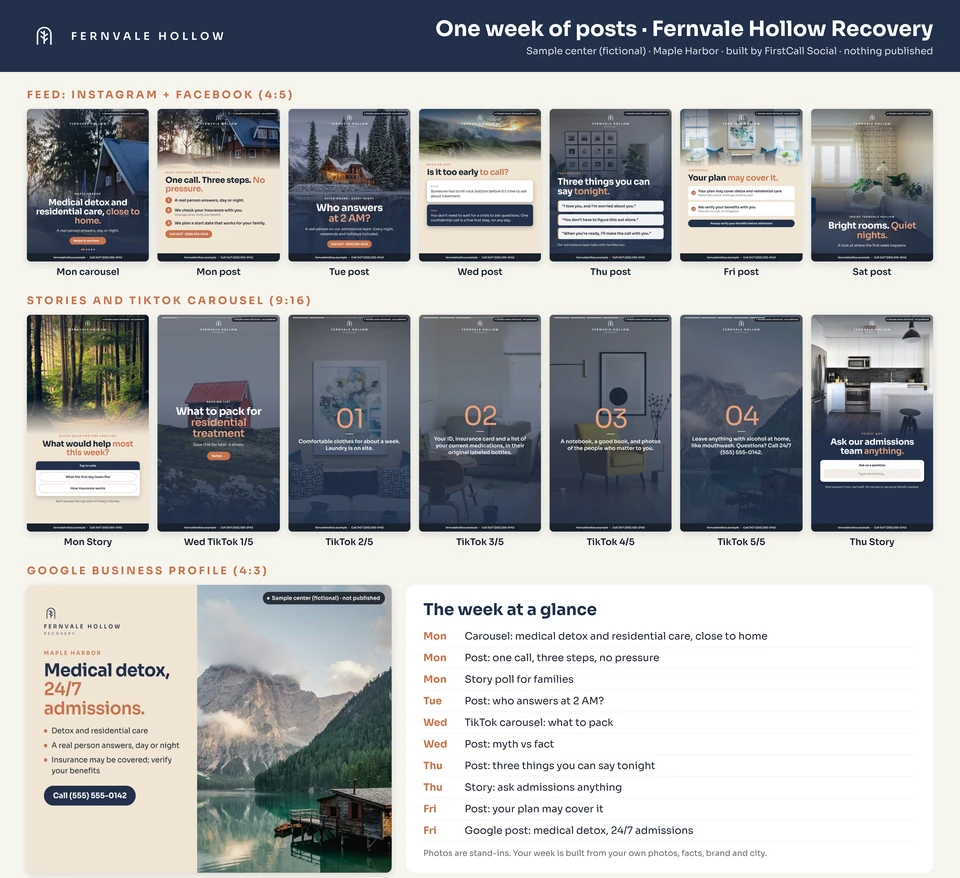
See a sample week
See what your feed could look like first. Get a free sample week, built from your website.
This article is general information, not legal advice. Talk to a healthcare attorney about your center.
Keep reading
- How often should a rehab post on social media? An example week
- Why your rehab's Instagram isn't growing, and how to fix it
- TikTok for treatment centers: what to post, what to avoid, and whether it's worth it
- Detox center marketing: a social media playbook for withdrawal management programs
This article is part of social media for treatment centers: the basics. Browse every guide by topic.
Planning for your market? See social media for treatment centers in your state, compare our flat monthly pricing, or grab the free 30-day calendar.