
If your rehab's Instagram is not growing, start with two checks you can run from the app today: whether Instagram is limiting your account, and how much of your reach comes from people who don't follow you. Then work through the seven common causes below. Every fix fits a treatment center's privacy rules.
First, check whether Instagram is limiting your account
Before you change anything, open Settings, then Account, then Account Status on your professional account. Instagram uses it to show whether your posts can be recommended to non-followers in Explore, Reels and Feed, and whether your account can appear in Search and Suggested Accounts. Instagram's creator guidance explains what it shows.
This matters for treatment centers. Instagram's recommendation guidelines limit content that "promotes the use of certain regulated products." Repeated problems, or something in your profile photo or bio, can make the whole account ineligible for recommendation for a period, per Instagram. Your followers still see your posts. Strangers don't, and strangers are where growth comes from.
If Account Status flags a post, edit or delete it. If you think Instagram got it wrong, request a review from the same screen. Then go back through your recent posts. We'd replace photos of pills, drinks or drug use, even in an educational post, with staff, the building or plain text.
Measure reach, not followers
Followers are the slowest number on the account. The useful number is accounts reached, split between followers and non-followers, in your Insights. Instagram points creators to this same split. If almost all of your reach comes from people who already follow you, the account isn't being shown to anyone new. Fix that first.
Check accounts reached once a week, on the same day, and write it down. That one line tells you whether the changes below are doing anything.
7 reasons your rehab Instagram is not growing
| Cause | How to check | The fix |
|---|---|---|
| 1. Long gaps between posts | Scroll your grid. Any gap of a week or more? | A fixed weekly schedule you can keep, even 5 posts a week |
| 2. Reposted or stock content | Count posts you didn't create yourself | Your own photos, staff clips and written posts |
| 3. No keywords people search | Read your handle, bio and last 5 captions | Level of care plus city, in plain words |
| 4. No Reels, or Reels built wrong | Check your Reels tab and their size | Full-screen vertical video, a clear first 3 seconds |
| 5. A bio that doesn't answer "what, where, how" | Read it as a worried parent would | Level of care, city, how to reach admissions |
| 6. Every post is an ad | Count posts that say "call now" | Mostly useful posts, one clear ask on some |
| 7. Nobody owns it | Ask who posted last and when | One owner, one schedule, a weekly review |
1. Long gaps between posts
A feed that goes quiet for three weeks looks closed to a family comparing programs at night. Pick a pace you can keep for a full year, not a burst you can keep for a month. Our guide on how often a rehab should post lays out an example week.
2. Reposted or stock content
Instagram says original content is something you filmed yourself or that hasn't been posted on Instagram before. Reshared quote graphics and stock photos of sad people at windows are the opposite. Your own building, your own staff and your own words beat any template.
3. No keywords people search
Instagram Search reads your handle, bio and captions, and Instagram says keywords in comments don't help. Families search the way they talk: "detox in Phoenix," "women's rehab Orange County," "IOP near me." Put your level of care and your city in the bio and in most captions.
4. No Reels, or Reels built wrong
Instagram's own tips for Reels: full-screen vertical video in 9:16, no borders, little text covering the frame, 3 minutes or less, and a hook in the first 3 seconds. A 30-second clip of your intake coordinator answering "What should I pack?" fits all of that.
5. A bio that doesn't answer what, where and how
A stranger lands on your profile for a few seconds. They need three answers: what level of care, where, and how to reach a person. "Healing starts here" answers none of them.
6. Every post is an ad
If every caption ends with "call now," people stop reading. Most posts should answer a real question. What happens on day one of detox? Can my mom visit? Do you take my insurance? Save the direct ask for some posts, not all of them.
7. Nobody owns it
In many centers, the admissions director posts between calls when there's time. There's rarely time. Someone has to own the schedule, or it slips. If no one on staff can own it, that is the point to hand it to a person or partner whose job it is.
What a treatment center can't do to grow
Most "grow your Instagram" advice was written for gyms and coffee shops. Some of it is risky for a rehab.
- Don't buy followers. Bought followers don't reach anyone new, and they make your reach numbers meaningless.
- Don't post patient stories, photos or testimonials. Not a first name, not a back-of-head shot, not a "graduation" post. Patient privacy rules for treatment programs are strict. Our guide on HIPAA and 42 CFR Part 2 on social media covers the basics.
- Don't promise results. No success rates, no "best rehab in the city," no before-and-after posts.
- Don't chase trends that joke about drinking or drugs. They may get views. They also tell a family you don't take this seriously.
This article is general information, not legal advice.
A weekly plan that fixes the basics
Here is a five-post week any center can run. It's built from your own facts, your own staff and your own building.
| Day | Post | Format |
|---|---|---|
| Monday | "What happens on your first day" walkthrough | Carousel |
| Tuesday | Staff member answers one common question | Reel, under 60 seconds |
| Wednesday | Insurance and cost question, answered plainly | Single image with text |
| Thursday | A room, the kitchen or the grounds, with a short caption | Photo |
| Friday | Family question: visiting, phone calls, what to pack | Reel or carousel |
No patients in any photo or video, including in the background, and a signed release before any staff member appears.
An example caption for Tuesday:
"Our intake coordinator gets asked this every week: 'Can I bring my phone to detox?' Here's the honest answer, and why. Questions about our detox program in [your city]? Our admissions team answers every message. If you're in crisis, call or text 988."
What changed when we fixed it on our own program
We tested this posting approach on our founder's own treatment program first: its Instagram reached 844 accounts in 5 days, up from 8, and one TikTok post passed 9,145 views. Individual results vary. Not a promise of results.
How FirstCall does it
FirstCall Social was founded by a treatment center owner, so every post follows the rules above: no patient content, no outcome claims, a signed release for anyone on camera, and a 988 line on every mental-health post. We write, check and publish your posts from a fact sheet you confirm. Sensitive topics get a second senior check, and you get a preview of next week's posts every Friday.
We charge a flat monthly fee from $997, never per lead or per admission. Essentials is $997 a month for 5 posts a week on Instagram and Facebook. Core is $1,997 for 10 a week with Stories. Premium, our most popular plan, is $2,997 for 15 to 20 a week with Stories and a weekly TikTok carousel reel. Elite is $4,997 for 20+ a week on all platforms, including Stories, TikTok and YouTube. The one-time onboarding fee is $500 on Essentials and Core, $1,000 on Premium and $2,000 on Elite. Plans are month to month; cancel with 30 days' notice. Details are on our pricing page.
You're live in about 10 business days. Your center gives about 2 hours in week one, then about 15 minutes a month. Before you decide, we'll build you a free sample week of posts from your website, and we reply within one business day. See how it works.
Frequently asked questions
Why is my rehab's Instagram reach so low?
Check Account Status first, since Instagram may not be recommending your posts to non-followers. Then look at how often you post, whether your content is original, and whether your bio and captions include your level of care and city.
Does Instagram restrict addiction treatment content?
Instagram's published recommendation guidance doesn't name treatment centers. It does limit content that promotes certain regulated products, which can limit reach to non-followers. We keep images of pills, alcohol or drug use out of posts, even educational ones.
How often should a treatment center post on Instagram?
Consistency matters more than volume. Five posts a week that never stop beat fifteen one week and none the next. Choose a pace your team or partner can keep all year.
Should we buy followers or use a growth service?
No. Bought followers don't reach anyone new, they muddy your Insights, and they can make a treatment center look less trustworthy to the families checking you out.
How long does it take to fix a stalled account?
There's no honest fixed timeline. Check Account Status, fix the profile, post on a steady schedule, and track accounts reached weekly. That number tells you whether it's working well before followers do.
See a sample week
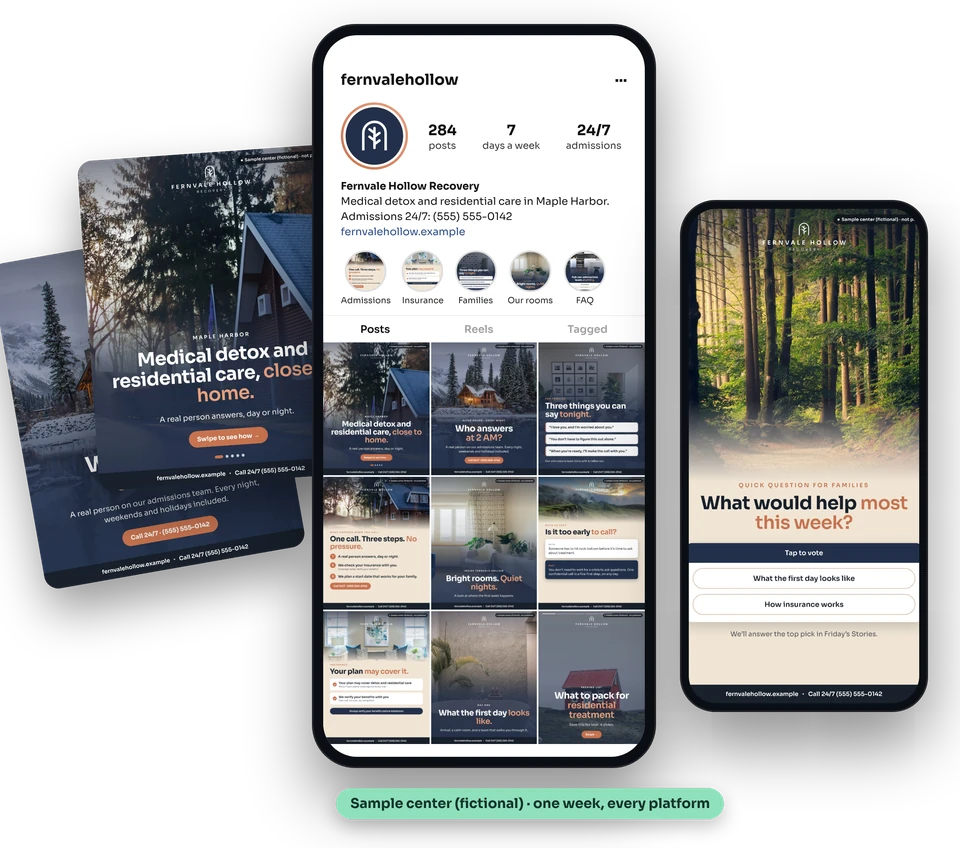
See what your feed could look like first. Get a free sample week, built from your website.
This article is general information, not legal advice. Talk to a healthcare attorney about your center.
Keep reading
- TikTok for treatment centers: what to post, what to avoid, and whether it's worth it
- Facebook for treatment centers: what to post, and what to avoid
- LinkedIn for treatment centers: how to reach referral partners
- Detox center marketing: a social media playbook for withdrawal management programs
This article is part of social media for treatment centers: the basics. Browse every guide by topic.
Planning for your market? See social media for treatment centers in your state, compare our flat monthly pricing, or grab the free 30-day calendar.