
IOP marketing on social media works when your feed answers one question clearly: can I get real help and still keep my life running? Intensive outpatient and partial hospitalization programs serve people who are deciding whether treatment fits around a job, kids and a commute. Your posts should show your schedule, your people and your process plainly, every week, so the person reading at 10 PM can picture Tuesday's group before they call.
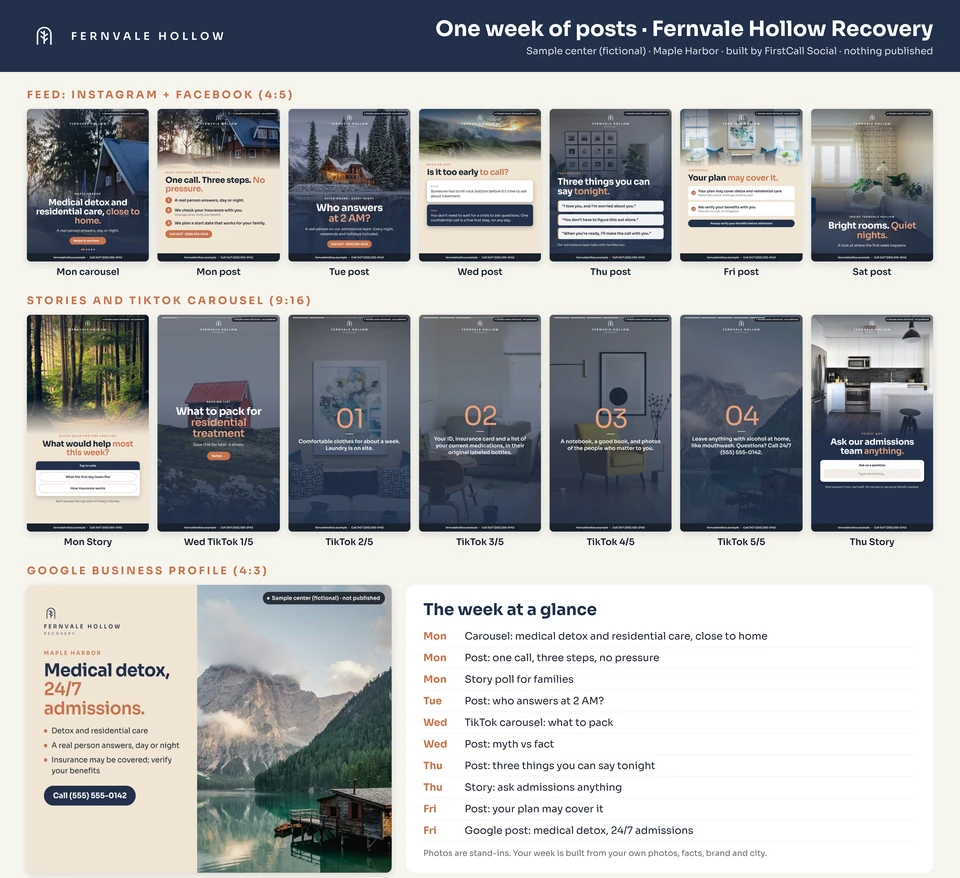
This guide covers who an IOP or PHP is really talking to, the questions they ask before calling, six post types that work, what to keep out of your feed, and a sample week you can copy.
IOP isn't detox, so don't market it like detox
A detox feed speaks to a crisis. An IOP feed speaks to a decision. SAMHSA's treatment guide on intensive outpatient care describes it as an intermediate level of care that can be an entry point, a step-down after residential or hospital care, or a step-up for someone who needs more than weekly outpatient (SAMHSA TIP 47, via NCBI). That means three different people are reading your posts:
| Who's reading | What they're weighing | What your feed should show |
|---|---|---|
| The person considering treatment | Work, kids, privacy, cost | Group times, evening tracks if you have them, what a first week looks like |
| A family member | "Is this enough?" | How IOP differs from residential, and how you decide together on the right level |
| A referral partner (residential program, therapist, EAP) | "Will my client be handled well?" | Your intake process, your clinical team, how you communicate on transitions |
Most IOP feeds only talk to the first group, and usually with a stock photo of a sunrise. Talk to all three.
The payer side matters too. Since January 1, 2024, Medicare has billing rules for intensive outpatient services from hospital outpatient departments, critical access hospital outpatient departments and community mental health centers, for patients whose plan of care calls for at least 9 hours of services a week (CMS MLN Matters MM13496). Whether that applies to your program depends on your setting and licenses, so check with your billing team before you post anything about coverage. What it does tell you: people are asking "is IOP covered?" more than they used to, and a post that says "we'll check your benefits for you, free" answers it without promising anything.
The questions people ask before they call an IOP
Build your feed around these. Each one is a post, a Story and a short video:
- "What time are groups?" Morning, afternoon, evening. Say it in plain words, with days.
- "Can I keep working?" Explain how your schedule works around a job, without promising an employer won't find out.
- "How long is the program?" Give the typical length you actually run and say it varies by person.
- "What happens in a day?" Group, individual sessions, any family sessions, in the order they happen.
- "Is this enough, or do I need residential?" Explain that a clinical assessment decides, and that you'll refer to a higher level of care if that's what's needed.
- "Do you take my insurance?" Offer a free, confidential benefits check. Never post "covered" or "free treatment" claims.
- "Is it virtual?" Only if you're licensed to provide telehealth in that state. Say which states, and never claim virtual is as good as or better than in person.
Six post types that work for IOP and PHP programs
1. The schedule card
One clean graphic: days, times, location, and "call to check a spot." Pin it. Update it the day anything changes. It's the kind of post people screenshot to check against their work calendar.
2. "A Tuesday in our evening IOP"
A carousel or a 30-second video that walks through a session in order, filmed in the empty group room. No clients on camera, no client stories. Just the room, the chairs, the coffee and a staff member explaining what happens at 6:00, 6:45 and 7:30.
3. Step-down explainer
For families of someone finishing residential care: what changes, what stays the same, and how the handoff works. Referral partners share these, because it makes their discharge conversation easier.
4. Meet the clinician
Your therapist or program director explains, in their own words, what they do in group. Signed release on file. One a week is plenty. Use the title their license allows and the one your site already shows.
5. IOP vs. PHP vs. outpatient
A myth-vs-fact or side-by-side carousel. Describe only levels of care you're licensed to provide, and send people to an assessment rather than a self-diagnosis.
6. For employers and referral partners
A short post on how someone can ask for time to attend treatment and what your team provides (attendance letters, for example, if you offer them). Keep it practical and point HR questions to the person's own HR team or attorney.
What to keep out of your IOP feed
The rules don't loosen because the program is outpatient:
- No patient information. No client faces, names, voices or stories, even "anonymous" ones that could identify someone in a small town. Our guide to HIPAA and 42 CFR Part 2 on social media covers why.
- No outcome claims. No success rates, "proven," "guaranteed" or "best IOP in town."
- No pay-per-lead marketing. Paying a marketer per call or admission can create legal risk under federal law. See our plain-language EKRA guide.
- No promises about jobs or privacy you can't control. Explain your process; don't guarantee what an employer will or won't learn.
A sample week for an IOP
| Day | Post | Format |
|---|---|---|
| Monday | Schedule card: this week's group times | Single image, pinned |
| Tuesday | "A Tuesday in our evening IOP" | Short video, empty room |
| Wednesday | Step-down: what changes after residential | Carousel |
| Thursday | Meet the clinician (signed release) | Short video |
| Friday | IOP vs. PHP vs. outpatient | Carousel |
| Saturday | For families: how to bring up an evening program | Carousel |
| Sunday | Free, confidential benefits check + 988 reminder | Story |
Every caption carries one local angle, a city or neighborhood you actually serve. If you're in a dense market like Connecticut, where families compare programs across several towns in one evening, that local line does a lot of work. Find your own state on our treatment centers by state page.
Don't forget Google and the people who click your ads
Many people looking for an IOP search "IOP near me" or "evening outpatient program" plus their town. Your Google Business Profile should list the same hours and levels of care as your feed. If you run paid ads, families who click through to your landing page often look you up before calling, so a current feed protects the clicks you pay for.
If your program also offers detox or residential, our detox center marketing playbook and mental health treatment center guide cover those audiences.
How FirstCall handles this for IOP and PHP programs
FirstCall Social was founded by a treatment center owner, so we know what step-down families and referral partners ask before they call. We write, design, check and publish your posts every week, from 5 to 20+ a week depending on your plan, for one flat monthly fee, never per lead, call or admission. Every post is checked for patient privacy and claims before it goes live. See what each plan includes.
Want to see it first? We'll build you a free sample week from your website, including a schedule card and a step-down post. Get a free sample week.
If you're in crisis, call or text 988.
Keep reading
- Social media for mental health treatment centers: what to post, what to avoid
- Dual diagnosis program marketing: social media for co-occurring care
- Behavioral telehealth marketing: social media for virtual care programs
- Social media marketing for addiction treatment centers: a practical guide
This article is part of playbooks by program type. Browse every guide by topic.
Planning for your market? See social media for treatment centers in your state, compare our flat monthly pricing, or grab the free 30-day calendar.