
Social media for a mental health treatment center has to do two things at once: make it easier for someone who is struggling to reach out, and never say anything that could hurt them or your license. In practice that means a feed that explains your levels of care in plain words, shows the real people and rooms behind the program, makes the first call feel less frightening, and ends every post with a safe next step. No diagnoses in captions, no promises, no patient stories, and 988 on every post.
This guide is for owners, clinical directors and admissions or marketing directors of residential mental health, PHP, IOP, outpatient and behavioral telehealth programs, including programs that treat co-occurring substance use and mental health conditions.
Why mental health content is different from rehab content
Most treatment center marketing advice is written for addiction programs. Mental health programs share the privacy rules and the trust problem, but three things change the plan:
- The reader may be in a hard moment right now. Someone scrolling your feed at 1 AM may be thinking about their own safety. Every post needs a calm tone and a clear crisis line, not urgency or alarm.
- People search by feeling, not diagnosis. Families type "my daughter won't leave her room" or "can't stop panicking," not a clinical term. Your content should meet them in those words, then explain the care you actually offer.
- Level of care is confusing. Residential, PHP, IOP, outpatient and telehealth all sound alike to a parent. A feed that explains the difference, and who each one is for, saves your admissions team a lot of calls that go nowhere.
What people check before they call a mental health program
When someone finds you through search, a referral, your Google Business Profile or FindTreatment.gov, they usually open your Instagram or Facebook next. In a few seconds, your feed should answer:
| Their question | What your feed should show |
|---|---|
| Is this a real, active program? | A post from this week, your real building and spaces, filmed with no patients in view |
| Is this the right level of care? | Plain-language posts on each level of care you're licensed for, and who it fits |
| Who will we be talking to? | Staff introductions, with written releases, in roles your website already shows |
| Will they judge us? | A warm, steady tone, real answers, and no stigma words |
| Do they take our insurance? | "Call for a free, confidential benefits check," not "we take all insurance" |
| What if it's an emergency? | 988, every time, and clear guidance that your admissions line isn't a crisis line if that's the case |
Families may also check your state licensing agency. Our state-by-state guides name the agency for each state, for example California and Colorado. Make sure your name, address and services match there and in your feed.
8 post types that work for mental health programs
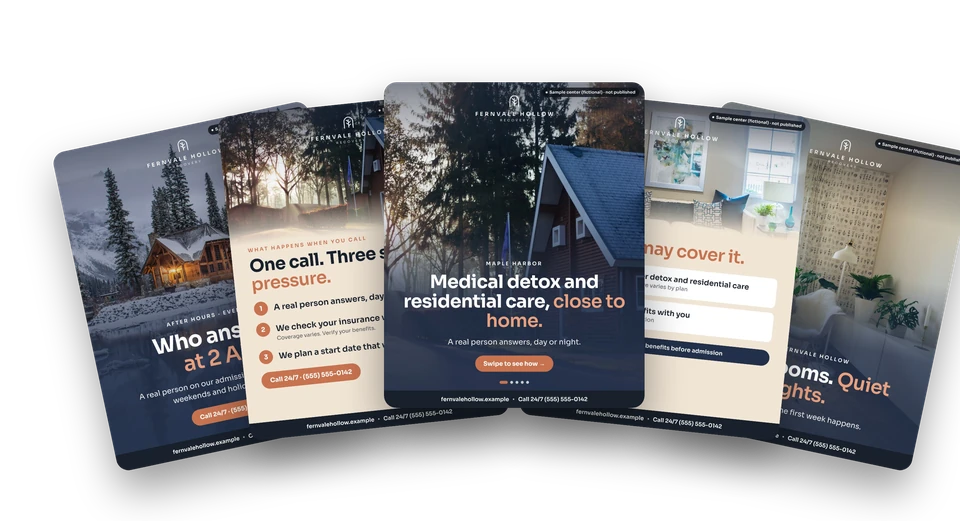
- "Is this the right level of care?" A carousel that explains residential, PHP, IOP and outpatient in one line each, naming only what you offer and pointing people to a call for an assessment.
- "What happens when you call us." Your real admissions steps: the first call, the benefits check, the assessment, the first day. Nothing you don't actually do.
- A day in the program. The schedule of a typical day (groups, individual sessions, meals, quiet time), shown with empty rooms and your staff, never participants.
- Meet the clinician. A 30-second video of a therapist or nurse on why they do this work and what the first session is like. Signed release on file.
- For parents and partners: how to start the conversation. What to say, what not to say, and when to call. Families save and share these.
- Myth vs. fact about getting help. Gentle, stigma-reducing posts: "Asking for help is not overreacting." Keep it educational, not diagnostic.
- Telehealth, explained. If you run a behavioral telehealth program, explain what a session looks like, what someone needs (a private room, a device) and which states you're licensed to serve. Don't compare it to in-person care.
- Your space, without people. The front door, a group room, a garden or a quiet corner. A room someone can picture walking into lowers the fear of the first visit.
Each post gets one location angle (your city, neighborhood or region) and one call to action. For more ideas, see 50 post ideas for treatment centers.
A sample week for a mental health program
| Day | Post | Format |
|---|---|---|
| Monday | Is this the right level of care? Residential, PHP, IOP and outpatient in plain words | Carousel |
| Tuesday | Meet the clinician: what your first session looks like | Short video |
| Wednesday | For parents: what to say when your teen or adult child is struggling | Carousel |
| Thursday | A day in the program, shown with empty rooms | Reel or Short |
| Friday | Weekend check-in: 988 and your admissions hours | Story |
| Saturday | Myth vs. fact: asking for help | Single image |
| Sunday | What happens when you call us | Carousel |
Daily posting across Instagram, Facebook, YouTube Shorts, TikTok and your Google profile is the standard to aim for. If that isn't realistic yet, three fixed days a week beats bursts and long silences. See how often a treatment center should post.
What a mental health center should never post
| Don't post | Why | Say instead |
|---|---|---|
| "We cure depression" or "anxiety-free in 30 days" | An outcome promise nobody can keep | "Our team builds a plan around each person" |
| "Take our quiz: do you have bipolar disorder?" | Reads as a diagnosis, and invites people to share health details in public | "Questions about what you're feeling? Call for a confidential assessment" |
| Client stories, photos or quotes, even "anonymous" | Patient privacy; details can identify someone | Staff, space and education content |
| A comment reply confirming someone is a client | A privacy disclosure, even if they posted first | A neutral reply and your admissions number, moved to a private channel |
| Graphic descriptions of self-harm or suicide | Can harm vulnerable readers | Calm, general language and the 988 line |
| "Better than in-person" for telehealth | A comparative claim you can't support | What a telehealth session looks like and who it fits |
Comments and DMs are where most privacy mistakes happen. Our guide to HIPAA and 42 CFR Part 2 on social media covers replies, DMs and reviews in detail, and applies to any program treating co-occurring substance use.
Paying for it: flat fee, not per patient
Mental health programs that also treat substance use should be careful with any marketing deal that pays per lead, call or admission. The federal Eliminating Kickbacks in Recovery Act makes it a crime to pay or receive remuneration for referrals to a recovery home or clinical treatment facility, with an exception only for pay that doesn't vary with the number of patients referred (18 U.S.C. 220). More in EKRA and treatment center marketing. A flat fee for defined work is the simpler structure; ask your healthcare attorney about any contract.
Doing it yourself vs. done for you
Doing this in-house takes someone who can film, write, check every post against your license and privacy rules, answer comments carefully and publish every day. In most programs that person also covers admissions or clinical work, and the feed goes quiet first.
FirstCall Social was founded by a treatment center owner to do this for mental health, addiction treatment, PHP, IOP and behavioral telehealth programs. We build every post from your confirmed fact sheet, check it for privacy and compliance before it publishes, and post 5 to 20+ times a week depending on your plan, organic only. Pricing is a flat monthly fee: Essentials $997, Core $1,997, Premium $2,997 and Elite $4,997, never per lead, call or admission. See pricing, how it works and our social media guide for treatment centers.
Frequently asked questions
What should a mental health treatment center post on social media? Plain explanations of your levels of care, your admissions steps, staff introductions with releases, your spaces without people in them, and education for families. End every post with 988.
Can we talk about specific conditions? Yes, as general education about conditions you're licensed to treat, written for a broad audience. Don't write captions that diagnose the reader, and never connect a condition to a real person.
Should a telehealth program post differently? Yes. Name the states you're licensed to serve in every relevant post, show what a session looks like, and never compare telehealth to in-person care.
See your feed first
Tell us about your program and we'll build you a free sample week from your website, before you spend anything. Get a free sample week.
If you're in crisis, call or text 988.
This article is general information, not legal advice. Talk to a healthcare attorney about your center.
Keep reading
- Dual diagnosis program marketing: social media for co-occurring care
- Behavioral telehealth marketing: social media for virtual care programs
- Sober living marketing: social media for recovery housing
- Social media marketing for addiction treatment centers: a practical guide
This article is part of playbooks by program type. Browse every guide by topic.
Planning for your market? See social media for treatment centers in your state, compare our flat monthly pricing, or grab the free 30-day calendar.