
Dual diagnosis program marketing on social media works when your feed answers one question before anyone asks it: will you treat all of me, or send me somewhere else for half of it? People with a mental health condition and a substance use problem have often been bounced between a therapist who won't touch the drinking and a rehab that won't touch the depression. Your posts need to show, plainly and every week, that one team handles both, who that team is, and what the first call sounds like.
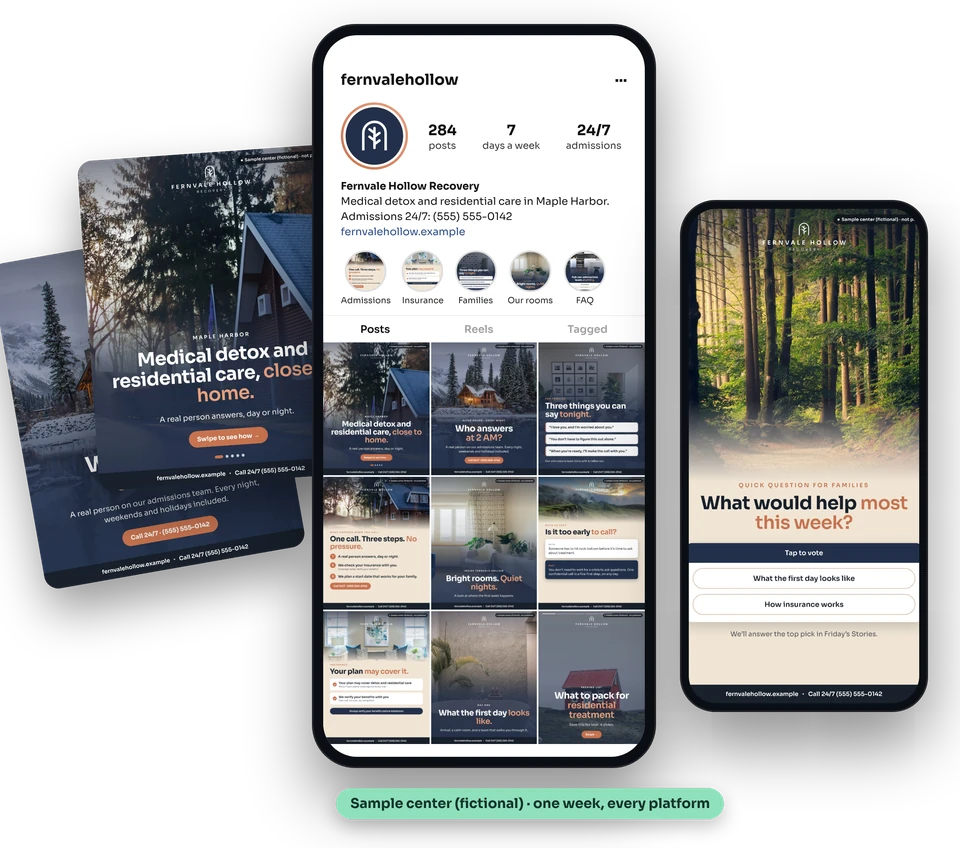
This guide covers who actually reads a dual diagnosis feed, how to explain integrated care without jargon, six post types that work, what to keep out of your feed, and a sample week you can copy.
Who is reading your feed
A dual diagnosis feed has more readers than most, and they want different things from the same post:
- The person who is struggling. Often reading late at night, unsure which problem to name first, worried they'll be judged or told they're "too complicated." They need calm, plain language and a clear next step.
- The family member. A parent or spouse who has watched one program fail because it only treated half the picture. They're comparing programs and want to know who is on the team and how the two sides work together.
- The referral partner. Therapists, psychiatrists, hospital social workers and other programs who need to know exactly which conditions and levels of care you accept, so they refer the right people.
Write for the first reader, and make sure the second and third can find what they need in the same caption or a pinned post.
Explain integrated care in plain words
"Integrated co-occurring treatment" means something to a clinician. To a family, it's jargon. Translate it into the things a person will actually experience:
- One team, one plan. "Your therapist and your addiction counselor talk to each other every week, and you have one treatment plan, not two."
- Who's on the team. Psychiatrist or psychiatric nurse practitioner, therapists, addiction counselors, nursing, case management, listed by role, and named only with a signed release.
- What a day looks like. Groups, individual sessions, medication management if you offer it, family sessions, in the order they happen.
- What happens if one side gets worse. How your team adjusts when anxiety spikes or a craving hits, described as a process, never a promise.
Every word about levels of care and conditions treated should match your license and your clinical director's sign-off. If your state licenses substance use and mental health programs separately, your posts should only describe the services you're licensed for. Our state guides list each state's licensing agency, and a state like Idaho or Florida has its own lookups families can use.
The questions people ask before they call
Collect these from your admissions team, then answer one per post:
- "Do I have to be sober before you'll treat my anxiety or depression?"
- "Will I see a psychiatrist, and how soon?"
- "Can I keep my current therapist or medication?"
- "What happens if I'm in detox and my mental health gets worse?"
- "Is this residential, PHP, IOP or outpatient, and how do you decide?"
- "What does insurance usually cover, and how do I check?"
Each answer should be short, accurate and end with the same next step: call admissions, or call or text 988 in a crisis.
Six post types that work for dual diagnosis programs
- "One team" carousel. Slide by slide, the roles on your clinical team and how they share one plan. No faces without releases; roles and empty offices work.
- Myth vs. fact. "Myth: you have to fix the drinking before anyone treats the depression." Explain how your program actually handles both, in your clinical director's words.
- A day in the program. The real schedule of a typical day, shown with empty group rooms, the kitchen and the outdoor space, never participants.
- Meet the psychiatrist or therapist. A short video, with a signed release, answering one admissions question in plain language.
- For families. How to talk to someone you love about getting help for both problems at once, what to say, what not to say, and when to call.
- First call, step by step. What admissions will ask, how long it takes, what information to have ready, and what happens next.
If you also run detox or an IOP, our detox center marketing playbook and IOP marketing guide cover those audiences, and our mental health treatment center guide goes deeper on mental health posts in general.
What to keep out of your feed
Dual diagnosis content touches two sensitive areas at once, so the line is tighter than usual:
- No diagnosing. No "5 signs you have bipolar disorder and an addiction" quizzes, no captions that tell a reader what they have.
- No patient stories or images. Not even anonymized "journeys." Anything that could identify a person in care stays out. Our guide to HIPAA and 42 CFR Part 2 on social media covers comments, DMs and reviews.
- No outcome claims. No success rates, "lasting recovery," "cure" or "best dual diagnosis program." Describe what you do, not what will happen.
- No medication promises. Explain that a licensed prescriber decides with each person whether medication is part of their plan. Don't name controlled medications in posts.
- No crisis left hanging. End every post with 988, and route crisis DMs to admissions right away.
A sample week for a dual diagnosis program
| Day | Post | Format |
|---|---|---|
| Monday | One team, one plan: who treats you here | Carousel |
| Tuesday | "Do I have to be sober first?" answered by your clinical director | Short video |
| Wednesday | A day in our program, room by room | Carousel |
| Thursday | For families: starting the conversation about both problems | Carousel |
| Friday | Your first call, step by step | Feed post |
| Saturday | Grounding skill for a hard weekend, from your therapy team | Story |
| Sunday | Admissions hours + 988 reminder | Story |
Every caption names your city or region and one level of care you're licensed for, so people searching locally can find you.
If you run ads for a dual diagnosis program
Your ads bring families to your landing page. Before they call, most look you up: Google, Instagram, Facebook, TikTok. If your feeds look dead, the click you paid for loses trust. A feed that explains integrated care and shows your real team backs up the ad. Read how to protect your ad spend.
How FirstCall helps
FirstCall Social was founded by a treatment center owner, so we know what families ask before they call because we're on the other end of that call too. We write, design, check and publish your posts every week, built from a fact sheet your clinical director confirms, with a compliance check on every post before it goes live. Organic only, for one flat monthly fee: Essentials $997, Core $1,997, Premium $2,997 or Elite $4,997, month to month. Compare plans on our pricing page.
Frequently asked questions
What is dual diagnosis marketing? It's marketing for programs that treat a mental health condition and a substance use disorder at the same time. On social media, that means explaining integrated care in plain words, showing the real clinical team, and making the first call feel less frightening, without diagnoses, patient stories or promises.
Can we post about specific conditions like depression or PTSD? You can explain what your program treats in general, plain terms, exactly as your license and clinical director allow. Don't diagnose anyone in a caption, don't use quizzes that label people, and never suggest a reader has a condition.
Should every dual diagnosis post include 988? Yes. Your audience includes people in a mental health crisis, so end every post with "If you're in crisis, call or text 988." and make sure DMs about crisis go to admissions, not a marketer's inbox.
Do you run ads for dual diagnosis programs? No. FirstCall is organic social media only, for one flat monthly fee. We never charge per lead, call or admission.
See your feed first
Tell us about your program and we'll build you a free sample week from your website, so you can see what a dual diagnosis feed could look like before you decide anything. Get a free sample week.
If you're in crisis, call or text 988.
This article is general information, not legal advice. Talk to a healthcare attorney about your center.
Keep reading
- Behavioral telehealth marketing: social media for virtual care programs
- Sober living marketing: social media for recovery housing
- Detox center marketing: a social media playbook for withdrawal management programs
- Social media marketing for addiction treatment centers: a practical guide
This article is part of playbooks by program type. Browse every guide by topic.
Planning for your market? See social media for treatment centers in your state, compare our flat monthly pricing, or grab the free 30-day calendar.