
Behavioral telehealth marketing on social media works when your feed answers two questions before anyone asks: can you see me where I live, and what actually happens on the first video visit? A virtual mental health or addiction program has no lobby to photograph and no building to drive past, so your posts are the front door. They need to name the states you serve, show the real people on the other side of the screen, and explain the first visit step by step, every week.
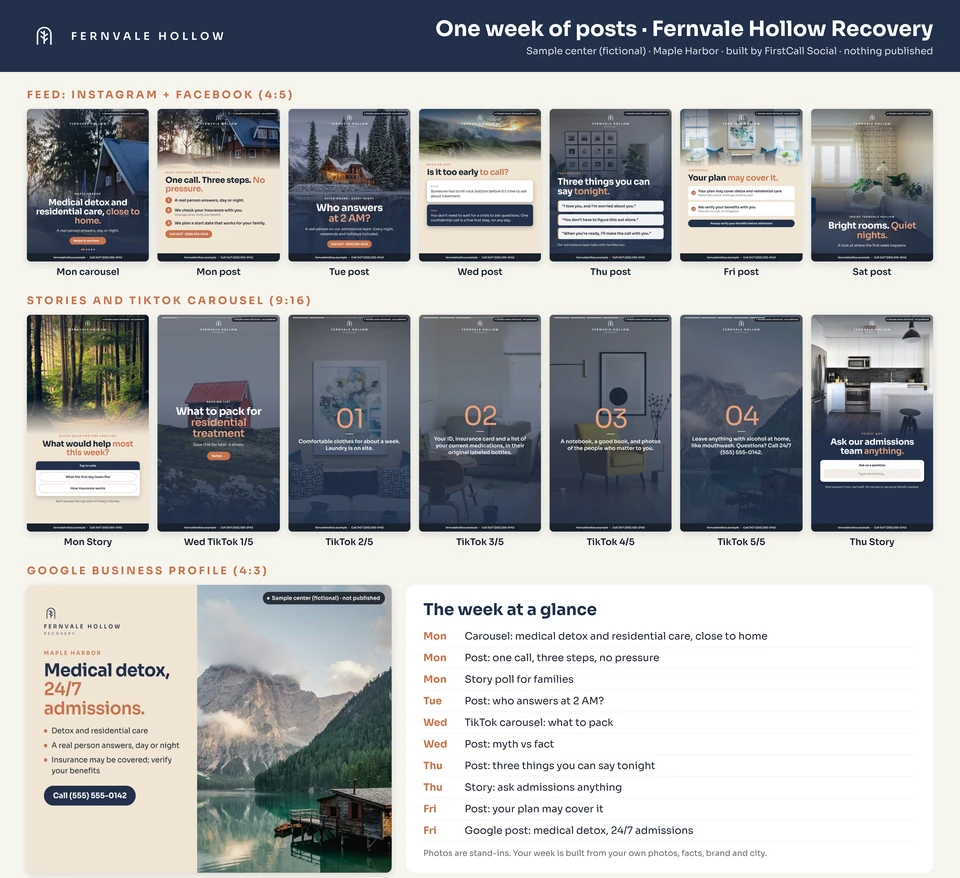
This guide covers the licensing line every telehealth post has to respect, what you can and can't say about prescribing, six post types that work, what to keep out of your feed, and a sample week you can copy.
Start with the states, because the law does
A brick-and-mortar program markets to a city. A telehealth program markets to every state its clinicians are licensed in, and nowhere else. The federal telehealth guide is plain about this: health professionals must be licensed or legally permitted to practice "in the state where the patient is located," and providers must follow the laws of the states where they're licensed and where the patient is (telehealth.hhs.gov, licensure for behavioral health). The same site tells providers to verify a patient's location and get consent before each appointment, and notes that interstate compacts let participating providers practice in participating states (telehealth.hhs.gov, licensing across state lines).
For your feed, that turns into three habits:
- Name your states in the bio and on a pinned post. "Virtual therapy and IOP for adults in Florida, Georgia and North Carolina" beats "online care, anywhere."
- Never imply nationwide coverage you don't have. A national-sounding hashtag or a map graphic with every state shaded can say more than your licenses do.
- Update the list the day it changes. A new state license or a lapsed one goes on your fact sheet first, then into the next week of posts.
Your state pages matter here too. If you serve Florida, Georgia or California, each state has its own licensing agency and its own questions families ask. Captions should carry the state and a city or region you actually serve, so people searching locally still find a virtual program.
What you can and can't say about prescribing
Many behavioral telehealth programs offer medication management, and people ask about it constantly. The federal rules here are temporary, which is exactly why your posts should stay general. HHS and the DEA extended the telemedicine flexibilities that "allow patients to receive prescriptions for controlled medications without a prior in-person visit" through December 31, 2026 (HHS announcement, January 2026; DEA).
That date is a reason to be careful, not a selling point:
- Don't post "get your prescription online" or name controlled medications. It reads like a pill mill ad and invites the wrong audience.
- Do explain the process. "A licensed clinician meets with you by video, reviews your history and decides with you whether medication is part of your plan" is accurate whatever the rules say next year.
- Keep dated rules off evergreen posts. If the flexibilities change after 2026, a post that never mentioned them doesn't need deleting.
When in doubt, your medical director and healthcare attorney decide what the feed says about prescribing. We build from the fact sheet they confirm.
The questions people ask before they book a telehealth visit
Build your feed around these. Each one is a post, a Story and a short video:
- "Do you see people in my state?" Answer with a list, not "most states."
- "What do I need for the first visit?" A phone or laptop, a private room, an ID, your insurance card if you're using it. Say it plainly.
- "Who will I actually talk to?" Show the clinician's face, name and license title, with a signed release on file.
- "Is it private?" Explain how you protect sessions in general terms. Never promise "100% confidential" or anything you can't control, like who else is in someone's house.
- "How fast can I start?" Describe your real intake steps. Don't promise same-day starts unless your fact sheet says you offer them.
- "Do you take my insurance?" Offer a free, confidential benefits check. Never post "covered" claims.
- "What if I need more than video?" Explain that a clinical assessment decides, and that you refer to in-person or higher levels of care when that's what someone needs.
Six post types that work for virtual programs
1. The state list card
One clean graphic: the states you serve, the services you offer in each, and "check your state" as the only ask. Pin it and update it the day anything changes.
2. "Your first video visit, step by step"
A carousel that walks through booking, the intake form, the waiting room link and the first ten minutes. Screens and staff only, no patients on camera.
3. Meet the clinician
A 30-second video from a therapist or nurse practitioner, filmed in the space they actually work from, saying what they do and which states they're licensed in. One a week is plenty.
4. Set up your space
Practical help: headphones, a parked car if home isn't private, a glass of water, what to do if the call drops. This is the post people save and share.
5. Telehealth or in person?
A calm explainer on who telehealth tends to fit and when an assessment points to in-person or a higher level of care. Never claim virtual care is as good as or better than in-person care; describe the format and let the assessment decide.
6. For referral partners
Primary care offices, EAPs and residential programs refer to virtual step-down care. A short post on how referrals work, how fast you respond and how you share updates with consent makes their job easier.
What to keep out of a telehealth feed
The screen doesn't loosen any rules:
- No patient information. No client faces, names, voices, screenshots of sessions or stories, even "anonymous" ones. Our guide to HIPAA and 42 CFR Part 2 on social media explains why.
- No outcome claims. No success rates, "proven," "guaranteed" or "best online therapy."
- No pay-per-lead marketing. Paying a marketer per sign-up, call or admission can create legal risk under federal law. See our plain-language EKRA guide.
- No states you aren't licensed in, no medication names and no promises about privacy at home.
A sample week for a behavioral telehealth program
| Day | Post | Format |
|---|---|---|
| Monday | The states we serve, and what we offer in each | Single image, pinned |
| Tuesday | Your first video visit, step by step | Carousel |
| Wednesday | Meet the clinician (signed release) | Short video |
| Thursday | Set up your space for a private session | Carousel |
| Friday | Telehealth or in person? How an assessment decides | Carousel |
| Saturday | For families: how to suggest a virtual first step | Carousel |
| Sunday | Free, confidential benefits check + 988 reminder | Story |
Every caption carries one state and one city or region you actually serve. If your program also runs an evening track, our IOP marketing guide covers schedule posts, and the mental health treatment center guide covers the families and referral partners who read along.
If you run ads for a virtual program
Telehealth programs often advertise across several states at once. Those ads send people to a landing page, and before they book, most look you up on Google, Instagram, Facebook and TikTok. A feed with a state list, real clinicians and a post from this week backs up the click you paid for. Read more on protecting your ad spend.
How FirstCall handles this for telehealth programs
FirstCall Social was founded by a treatment center owner, so we know what people ask before a first appointment. We write, design, check and publish your posts every week, from 5 to 20+ a week depending on your plan, for one flat monthly fee, never per lead, call, sign-up or admission. Your licensed states go on a fact sheet you confirm, and every caption follows it. See what each plan includes, or browse social media for treatment centers by state.
Want to see it first? We'll build you a free sample week from your website, including a state list card and a first-visit carousel. Get a free sample week.
If you're in crisis, call or text 988.
This article is general information, not legal advice. Talk to a healthcare attorney about your center.
Keep reading
- Sober living marketing: social media for recovery housing
- Detox center marketing: a social media playbook for withdrawal management programs
- IOP marketing: social media for intensive outpatient and PHP programs
- Social media marketing for addiction treatment centers: a practical guide
This article is part of playbooks by program type. Browse every guide by topic.
Planning for your market? See social media for treatment centers in your state, compare our flat monthly pricing, or grab the free 30-day calendar.