
Here's a pattern that plays out every day. A treatment center runs Google ads every month. The campaigns are set up well, the landing page is clean, and the clicks come in. A mother taps the ad and reads the landing page. Before she calls, she searches the center's name and opens its Instagram to see if the place is real. The last post is a Fourth of July graphic from last year.
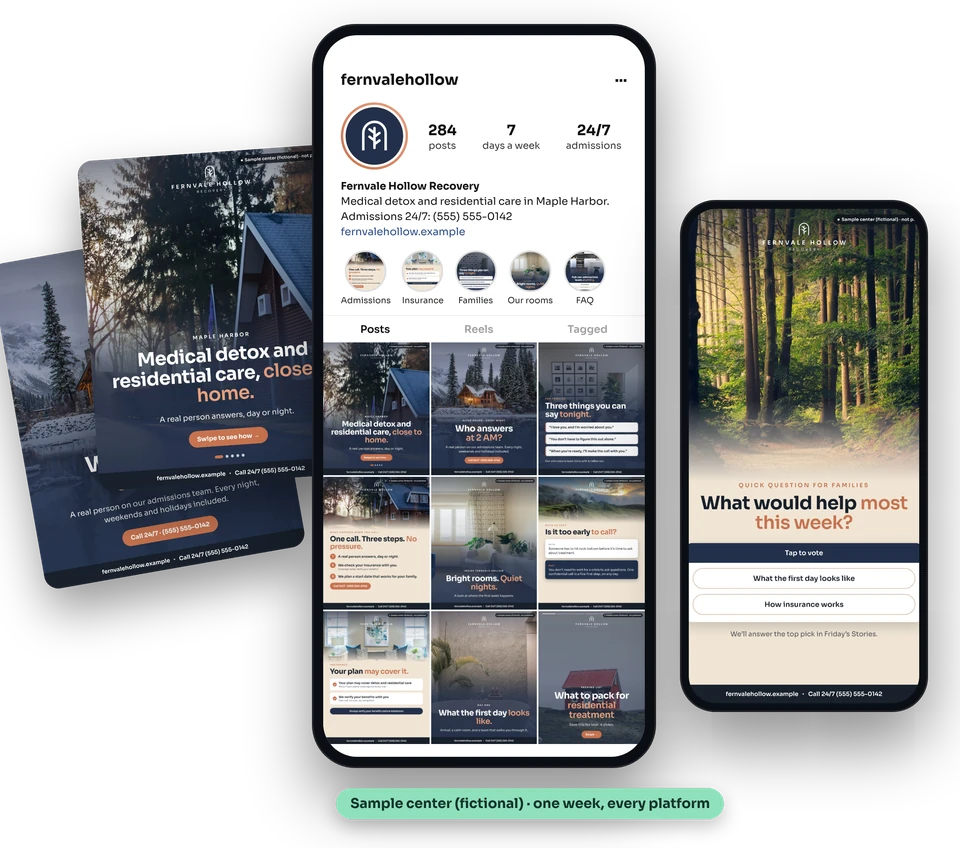
She doesn't call. Nobody tells the center why.
If you spend money on ads, your social media isn't a side project. Your ads bring families to your landing page. Before they call, most look you up: Google, Instagram, Facebook, TikTok. If your feeds look dead, the click you paid for loses trust. This post covers what families actually do after they click, why a quiet feed quietly undoes the ad, and how to protect your ad spend without spending more on ads.
The click isn't the decision
An ad does one job: it gets someone from a search to your landing page. It can't make them trust you. That happens next, and it happens fast.
Most people look a business up somewhere other than its own website before they trust it. A website is the version of you that you wrote. Social media feels like the version that's actually happening. Families looking for treatment do the same, with more at stake. They're scared, often searching late at night, often for someone who hasn't agreed to go yet. So after the click, they look you up and check:
- Is this place open? When was the last post?
- Is it real? Are those their rooms, or stock photos?
- Who would be there? Is there a single staff face anywhere?
- Does it match? Is the phone number in the bio the same one as the ad?
Your landing page can't answer those questions for them. Your Instagram, Facebook, TikTok and Google profile will, for better or worse.
What you're already paying to get them there
Addiction treatment advertising costs money before you buy a single click. LegitScript says its certification is required to run addiction treatment ads on platforms including Google and Meta, and it charges an application fee plus an annual fee per facility (LegitScript). Then come the monthly ad budget and, usually, a management fee. We break down every line in how much rehab marketing costs.
We're not here to tell you whether your ads are worth it. That's between you and whoever runs them. Our point is simpler: once you've paid for all of that, the pages the family looks up next shouldn't be the weakest link.
What a dead feed says without saying it
A feed that stopped months ago doesn't look neutral. It sends signals your ad never would:
| What they see | What they wonder |
|---|---|
| Last post from five months ago | "Are they still open?" |
| Holiday graphics and quotes, no people | "Who actually works there?" |
| An old phone number or a program you've dropped | "Is this even the same place?" |
| Comments from strangers with no reply in weeks | "Will anyone answer if I call?" |
That last one matters more than it looks. A family deciding whether to make a hard phone call is looking for any sign that someone on the other end is paying attention. A feed that went quiet is a small sign that nobody is.
And remember what happens when they leave: they go back to the search results, where your competitors' ads are still running.
Current beats big
Most owners hear "social media" and think followers. For this job, follower count barely matters.
Someone who clicked your ad two minutes ago isn't comparing your 600 followers to the center across town. They're checking dates, faces and details. A small account with a post from yesterday reads as open. A large account that went silent in spring reads as closed.
That's the good news. You don't have to build a huge audience to fix this. You need a feed that is current, real and accurate, every week:
- Current: something new every week, ideally every day, so the top of the feed is never old.
- Real: your rooms, your grounds, your staff explaining what they do, with signed releases on file for anyone on camera.
- Accurate: the same phone number, levels of care and license wording as your ads and website.
If daily posting sounds like a lot, our example week for rehab social media shows how the same few ideas stretch across platforms. Running ads for an outpatient program? Our IOP marketing guide shows what step-down families and working adults check first, and our state-by-state guides cover local licensing details, from Florida to California.
Run the two-minute ad check
Do this today, on your phone, the way a parent would:
- Search like a family. Try "detox near me" or "rehab in" plus your city. Find your own ad or listing and tap it.
- Look yourself up. Read the landing page, then search your center's name on Google and open your Instagram, Facebook and TikTok.
- Look at the top three posts. How old are they? Is there a person in any of them?
- Check the bio. Is the phone number the one in your ad? Is every level of care still accurate?
- Ask the honest question. If this were your son, would this feed make you more likely to call, or less?
If you winced at step three, you're not alone. Most teams are busy caring for clients, and social media gets done last.
What to post so they find something alive
You don't need clever content. You need content that answers what a worried family is wondering in that moment:
- The first-call questions. "How long does detox take?" "What happens when I call?" "Do you check insurance?" Answered honestly, without promises.
- Your people. A 30-second staff video does more for trust than any graphic.
- Your space. Rooms and grounds, filmed empty, in natural light.
- Help for families. What to say, what to pack, how to start the conversation.
Keep it inside the rules: no patient stories without releases, no outcome claims, nothing that confirms someone was a patient. Our 50 post ideas for treatment centers has a full list.
Why we built FirstCall around this
FirstCall Social was founded by a treatment center owner. He knows what families check before they call because he's on the other end of that call. The system was built and tested inside a working treatment center before it was offered to anyone else.
We're organic only. We don't run your ads, manage your budget or charge per lead, call or admission. We write, design, check and publish your posts every week, from 5 to 20+ a week depending on your plan, for one flat monthly fee: Essentials $997, Core $1,997, Premium $2,997 or Elite $4,997. We can't promise calls or admissions, and nobody honestly can. We make sure that when families look you up after the click, they find a center that looks like someone's there. See how a current feed protects your ad spend, or how it works.
Running ads for a specific program or state?
Families check different things depending on the program they clicked on. Our playbooks for detox centers, IOP and PHP, dual diagnosis programs and behavioral telehealth cover what each audience looks for after the click. If you advertise in one state, our state guides, such as Kentucky and Louisiana, cover each state's licensing agency and local search angles, from Florida and Georgia to Hawaii and Idaho.
Build your brand while you help people
Here's the bigger question for owners: are you building a brand while you help people?
Most owners and their teams spend their days helping people. That's the job, and it should come first. But ads rent attention for as long as you pay. A brand is what families find, and remember, when they look you up, and it keeps building whether or not a campaign is running.
That's the other half of what we do: we build the brand for you. We come up with the ideas, write, design and post the content, so your center shows up everywhere families look. It supports the ad spend and revenue work you already have going without adding to your team's week.
Frequently asked questions
Do we need social media if we already run ads? If you run ads, you arguably need it more. Paid clicks bring people to your landing page, and many of them will look you up on social before they call. A current feed makes sure what they find matches what your ad promised.
How recent does our last post need to be? There's no official rule, but think like a family: if the top post is from this week, you look open. If it's from last season, they start to wonder. Weekly at a minimum, daily if you can.
Does a small follower count hurt us? Not for this. Someone checking you after an ad click is looking at dates, faces and details, not your follower count.
Should our ads link to our Instagram page? No. Paid ads should go to your landing page, where families can see your programs and call admissions. Your social feeds do a different job: they are what families find when they look you up before they call, so keep them current. Our protect your ad spend page shows how the two fit together.
Will FirstCall run or manage our ads? No. FirstCall is organic social media only. We don't run ads, manage ad budgets or charge per lead, call or admission. You pay one flat monthly fee for the posts we create and publish. Compare plans on our pricing page.
See your feed first
Tell us about your center and we'll build you a free sample week from your website, so you can see what families could find when they look you up after your next paid click. Get a free sample week.
If you're in crisis, call or text 988.
Keep reading
- Social media doesn't replace your SEO and ads. It makes them work better.
- Why your SEO and PPC clients need social (and how to add it without hiring)
- How much does rehab marketing cost? Agency pricing explained
This article is part of ads, SEO and social working together. Browse every guide by topic.
Planning for your market? See social media for treatment centers in your state, compare our flat monthly pricing, or grab the free 30-day calendar.