
YouTube for treatment centers comes down to one job: answer, on camera, the questions families already search for, and show them the real place before they call. You don't need a studio or a ten-minute documentary. You need short, honest videos of your rooms, your staff and your process, posted every week, so that when someone searches your name or "what is detox like," they see a program that looks open and real.
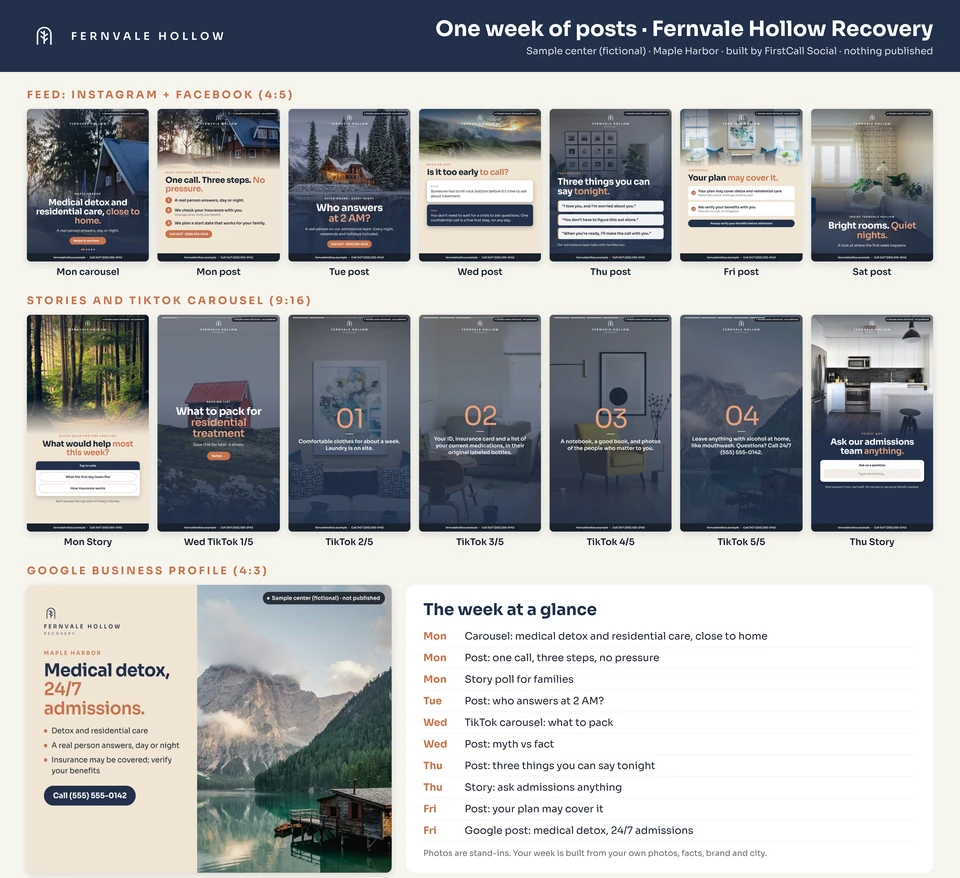
This guide covers why YouTube matters for addiction treatment, mental health and behavioral telehealth programs, the five video types that work, what to keep out of every frame, and a simple weekly plan.
Why YouTube is different from your other feeds
Instagram, Facebook and TikTok mostly show people what's new. YouTube also works like a search engine: people type a question and watch the answer. That makes it a natural fit for treatment, because the questions people ask before calling are specific and practical:
- "What happens on the first day of detox?"
- "What does a residential treatment room look like?"
- "Can I keep my phone in rehab?"
- "What's the difference between IOP and PHP?"
- "How do I talk to my son about treatment?"
A video that answers one of those plainly can keep being found for months. A feed post usually fades in days.
There's a second reason. When someone searches your center's name, Google often shows video results and your YouTube channel alongside your website and Google Business Profile. A channel with recent videos looks like a center someone runs. A channel whose last upload was a 2021 grand-opening video looks like the opposite.
Shorts are the easy way in
Shorts are vertical videos, and YouTube now lets them run up to three minutes (YouTube Help). For a treatment center, 30 to 60 seconds is plenty. That's long enough for one question, one clear answer and one next step, and short enough that a staff member can record it between groups.
The best part: the same vertical video often works on Instagram Reels, TikTok and Facebook too. You film once and adapt the caption and cover for each platform. That's how a center gets to the posting rhythm in our guide on how often a rehab should post without a full-time video team.
Five YouTube videos every treatment center can make
1. The walk-through tour
Walk through the building in one steady take: the front door, the intake room, a bedroom, the group room, the kitchen, the outdoor space. Film when no clients are present. Narrate it with what actually happens in each room. This is the video families watch most before they visit, and it answers "is this place real?" faster than any photo.
2. The one-question answer
A clinician or admissions coordinator answers one search question in under a minute. "What should I pack?" "Can my family visit?" "How long does detox usually take?" Keep the answer general and accurate, say that a clinical assessment decides the plan, and end with how to reach admissions. Make a list of the 20 questions your admissions team hears most and you have five months of weekly Shorts.
3. Meet the team
A staff member explains, in their own words, what they do and why they do it. Use the title their license allows and the one your website already shows. Signed release on file. These videos make the first phone call feel less like calling a stranger.
4. The level-of-care explainer
Detox, residential, PHP, IOP, outpatient, telehealth: families don't know the difference, and most guesses are wrong. A short explainer, with simple on-screen text, helps them ask better questions. Describe only the levels of care you're licensed to provide. If you run an outpatient track, our IOP marketing guide has more angles; detox programs should see the detox center marketing playbook.
5. For families
"How do I bring up treatment?" "What do I say if he says no?" "What happens when I call?" Families are often the ones searching late at night. Speak to them directly, with calm, practical steps and no pressure. For a mental health program, end every one of these with: "If you're in crisis, call or text 988."
Make each video easy to find
YouTube can only recommend what it understands. For every upload:
- Title it like the search. "What happens on the first day of detox" beats "Day One at Our Center."
- Say your city out loud and in the description. One local angle per video: your city, county or region. Our state pages show how we rotate those angles. A center in Massachusetts, for example, might rotate Boston, Worcester, the North Shore and Western Mass.
- Add captions. Captions help anyone watching with the sound off, and viewers who are deaf or hard of hearing. Check every auto-caption by hand, especially drug names, program names and your phone number.
- Use a clear cover frame. Readable text, a real person or room, nothing clipped.
- One call to action. Call admissions, or visit the page with your programs. Not both, not five.
What to keep out of every frame
Video makes privacy mistakes easier, because a camera picks up more than you notice. Before anything is posted:
- No clients, ever. No faces, voices, names, first-person stories or "anonymous" stories that could identify someone. Check the background for whiteboards, schedules, name tags, sign-in sheets and anyone walking past a window. Our guide to HIPAA and 42 CFR Part 2 on social media covers why this matters so much in substance use treatment.
- No outcome claims. No success rates, "proven," "guaranteed" or "best rehab in the state," in the video, the title or the description.
- No medical advice in the comments. Reply to comments with a kind line and your admissions number, never with advice about someone's situation. Hide or remove comments where someone shares their own health details.
- No pay-per-lead promotion deals. If anyone offers to promote your videos and get paid per call or admission, read our plain-language EKRA guide first.
A simple weekly YouTube plan
| Day | Video | Length |
|---|---|---|
| Monday | One-question answer: "What should I pack?" | 45 seconds |
| Wednesday | Meet the team: your admissions coordinator | 60 seconds |
| Friday | For families: "What happens when you call us" | 60 seconds |
| Once a month | Walk-through tour, refreshed when anything changes | 2 to 3 minutes |
Three Shorts a week and a monthly tour is a realistic rhythm for most programs. Repost each Short to Reels, TikTok and Facebook with a caption written for that platform, so one recording does four jobs.
Where this fits with your ads
If you run paid ads, those ads take people to your landing page. Before they call, most look you up: Google, Instagram, Facebook, TikTok, and often YouTube results right on the search page. If your channel is empty, the click you paid for loses trust. A current channel with your real rooms and staff backs it up. Read what families do after they click your ad.
How FirstCall handles YouTube for treatment centers
FirstCall Social was founded by a treatment center owner, so we know the questions families ask before they call and the privacy lines video can cross. We plan, write, edit, check and publish your posts every week, from 5 to 20+ a week depending on your plan, and Elite includes YouTube posts every week. It's one flat monthly fee, never per lead, call or admission, and every video is checked for patient privacy and claims before it goes live. See what each plan includes.
Want to see it first? We'll build you a free sample week from your website. Get a free sample week.
Keep reading
- Google Business Profile for rehab centers: weekly posts that help locals find you
- Social media marketing for addiction treatment centers: a practical guide
- 50 social media post ideas for treatment centers, and how to keep them coming every week
- Detox center marketing: a social media playbook for withdrawal management programs
This article is part of social media for treatment centers: the basics. Browse every guide by topic.
Planning for your market? See social media for treatment centers in your state, compare our flat monthly pricing, or grab the free 30-day calendar.